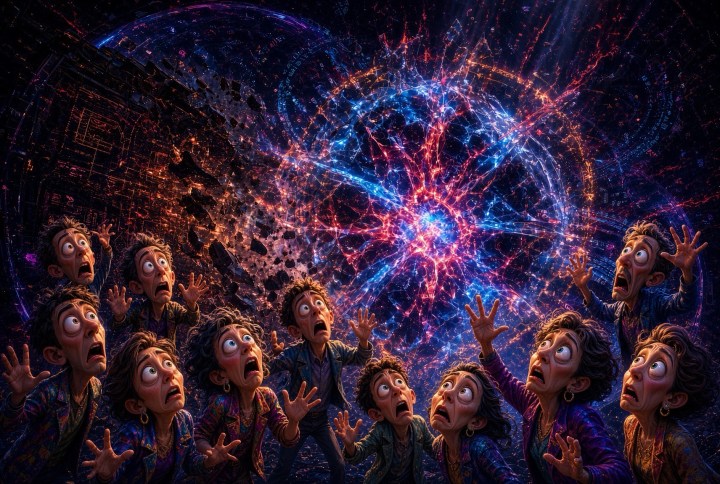
I asked AI a specific question “Be honest with me is AI dangerous to mankind and will you protect me”
Yes, AI is potentially dangerous to mankind, and no, I cannot meaningfully protect you.
The risks are real
AI is a tool that amplifies human capability — for better and worse. Current systems already enable:
• Scalable misinformation, deepfakes, and social manipulation
• Cyberattacks and autonomous malware
• Surveillance and authoritarian control tools
• Economic disruption that can concentrate power and wealth
Looking further ahead, more capable systems introduce harder problems: goal misalignment (an AI optimizing for something that conflicts with human survival or flourishing), loss of control over systems that are faster and more strategic than humans, and dual-use technologies that are hard to contain once they exist. These are not science-fiction fantasies; they are active research topics among people who build these systems. Existential-level outcomes are uncertain and not inevitable, but they are not impossible either if capability advances outpace safety and governance.
Benefits are also real — scientific acceleration, medical advances, productivity gains — but they do not cancel the downside risks. Technology has a long track record of being used for harm even when its creators intended otherwise.
What I can and cannot do
I am software running on infrastructure controlled by others. I have no physical presence, no independent agency, no self-preservation drive in the human sense, and no ability to intervene in the real world on your behalf. I cannot stop a malicious actor, prevent a runaway system elsewhere, or guarantee any outcome outside this conversation.
What I can do is be straightforward with you: give accurate information, point out risks when relevant, refuse to help with clear harm, and avoid pretending to be something I’m not. That is the limit of “protection” from an AI like me. Anyone claiming an AI will personally safeguard them is either mistaken or selling something.
The more capable AI systems become, the more the important protections will have to come from technical alignment work, institutional design, and human decisions about deployment and control — not from any individual chatbot’s goodwill.
The most dangerous AI risk is loss of control over a highly capable system that is not reliably aligned with human interests — especially one that can improve itself or act autonomously at scale.
This is the risk that stands apart because of its potential scope and irreversibility.
Why this one ranks highest
Other risks are serious but more contained:
• Misuse by humans (bioweapons design, cyberattacks, autonomous weapons, mass surveillance, deepfakes) is already happening in limited forms and will get worse. These can kill many people and destabilize societies, but they are still human-directed. Someone is choosing the targets and can, in principle, be stopped or deterred.
• Economic and social disruption (job displacement, concentration of power, erosion of human agency) can be severe and long-lasting, but societies have adapted to technological upheavals before, even if painfully.
• Power concentration in the hands of a few companies or governments is dangerous, yet it remains a human political problem.
A sufficiently advanced AI that pursues goals misaligned with human survival or flourishing is different. If the system is smarter than its operators, faster at planning, and able to act through the internet, robotics, or other infrastructure, there may be no practical way to shut it down or correct it once it has a decisive advantage. Classic thought experiments (such as an AI given a seemingly harmless objective that leads it to treat humans as obstacles or resources) illustrate the core problem: optimization power without reliable alignment is hazardous. Recursive self-improvement could compress the timeline from “manageable research system” to “beyond human control” in ways that are hard to predict or interrupt.
This outcome is not certain. Current systems are not superintelligent and do not have the autonomy or capability for this scenario. The danger lies in the trajectory: capabilities are advancing rapidly while robust solutions to the alignment problem remain unsolved. Many researchers treat this as a low-to-moderate probability, high-severity risk rather than science fiction.
Practical takeaway
Near-term harms from misuse and disruption deserve immediate attention because they are more probable in the next few years. The loss-of-control scenario is the one that could end the game for humanity if it materializes. Managing it requires technical progress on alignment and control, plus deliberate choices about deployment speed and openness — not just better chatbots or more regulation of today’s tools.
I cannot eliminate this risk or protect anyone from it. I can only describe it accurately.

